In many leadership conversations, politics is treated as a dirty word.
“I don’t do politics.”
“It feels manipulative.”
“That’s not how I want to lead.”
I hear this frequently from senior women leaders — highly competent, strategic, resilient women who have already proven themselves through performance. Yet, as they move into the most senior levels of organisations, many encounter a different kind of barrier: not a lack of capability, but a lack of clarity about power.
This is my inquiry into that edge.
What is really happening when women label something as “political”?
What are we avoiding, protecting, or misunderstanding about power?
And how might women reclaim a more conscious, grounded, and skilful relationship with it?
When “Politics” Becomes a Convenient Deflection
In many corporate cultures, politics becomes shorthand for discomfort.
When women say, “I don’t do politics,” it often masks deeper experiences such as:
- not wanting to manipulate or play games
- not understanding the unspoken rules of the system
- feeling unsafe, unseen, or excluded
- not trusting oneself — or others — in power-laden spaces
Labelling something as “political” can serve a protective function. It allows us to step back from:
- power dynamics — who has influence and why
- ambition — our own desire to shape outcomes
- conflict — the reality that leadership involves tension and disagreement
- shadow motives — control, validation, insecurity, in ourselves and others
By naming politics as “dirty” or “toxic,” it becomes easier to remain on moral high ground: I’m above that.
But over time, this can turn into a subtle withdrawal of agency.
What Is Beneath Corporate Politics?
Politics does exist in organisations — but not always in the way it is imagined.
Much of what is called “politics” is simply the human system at work:
- relationships, alliances, and trust networks
- unspoken values and fears that shape decisions
- dynamics of status, belonging, and authority in complex environments
When these dynamics remain unconscious, politics can indeed become manipulative or exclusionary.
When they are made conscious, they become something else entirely:
a map of how power, influence, and decision-making actually flow.
The core question then shifts from:
How do I avoid politics?
to
How do I read and work with power consciously?
The Landscape Senior Women Are Navigating
At senior levels — particularly in large global corporates — leadership work changes.
Progress is no longer primarily about technical mastery or execution. It becomes about influence:
- who is listened to
- whose voice carries weight
- where decisions are shaped before they are formalised
- how visibility and sponsorship operate
Many women describe this moment clearly:
“I can see there’s a game being played — but I don’t know the rules.”
This disorientation is not about competence. It is about political opacity.
Because the rules are unwritten and often shaped by long-standing, male-coded norms, women frequently feel pulled into an impossible choice:
- mimic existing behaviours and lose authenticity, or
- reject politics altogether and lose influence
Neither is sustainable.
What “I Don’t Know the Rules” Is Really Pointing To
This statement often hides three deeper tensions:
1. Fear of losing integrity
“If I engage, I’ll become someone I don’t respect.”
A desire to remain values-led collides with a fear that power corrupts.
2. Ambivalence about power itself
“I want influence — but I don’t want to want it.”
Many women carry an inherited belief that ambition is aggressive or self-serving.
3. Lack of political literacy
“I sense what’s happening, but I can’t name it or navigate it.”
Political skill is rarely taught explicitly, despite being essential at senior levels
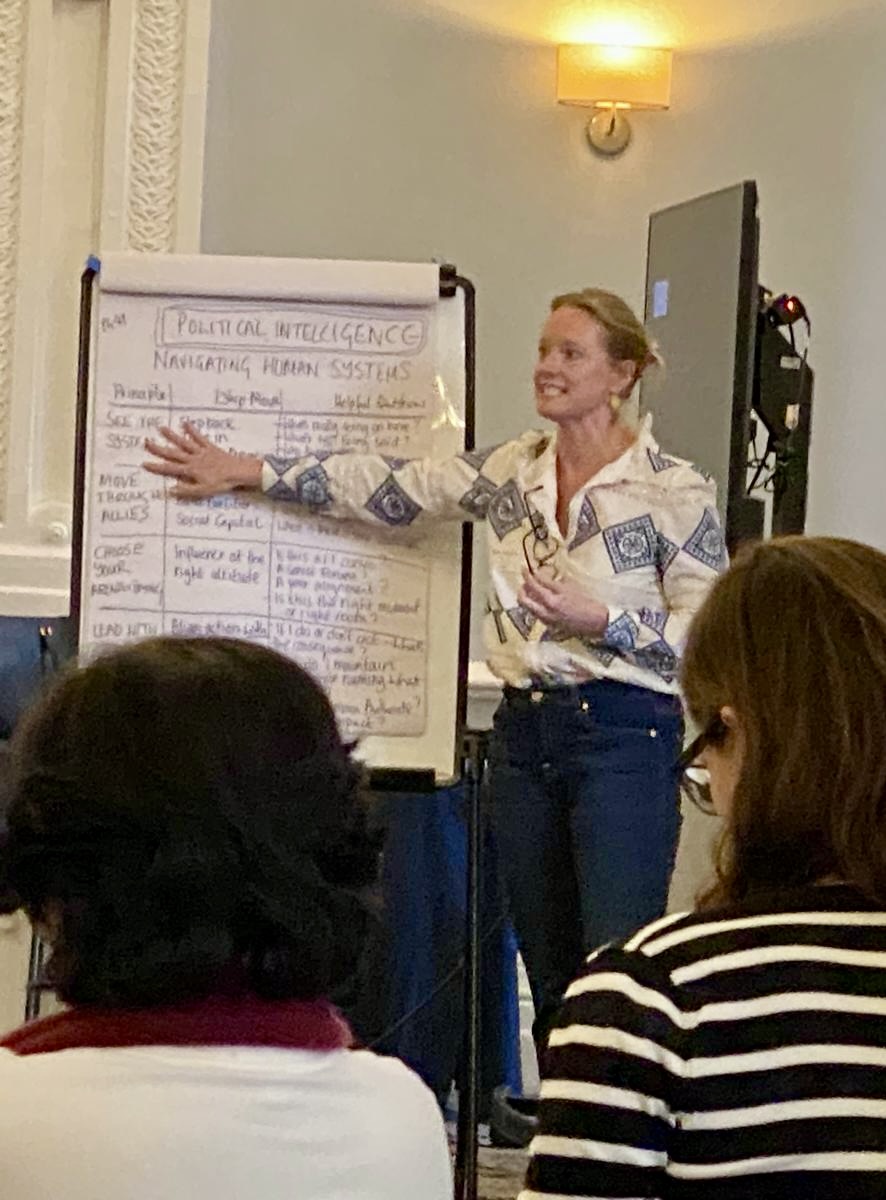
Reframing Politics as Relational Power Intelligence
A more helpful framing is this:
Politics is the art of understanding and influencing human systems of power — with awareness, integrity, and care.
This reframing matters.
It shifts the stance from avoidance to conscious engagement, and it invites women to:
- read influence and energy flows as information
- build alliances and sponsorship intentionally
- communicate strategically without self-abandonment
- work with ego, fear, and hierarchy — in themselves and others — with maturity
This is not selling out.
It is growing up in the system without being swallowed by it.
Becoming More Resourced to Engage Power
What helps women step into this territory more confidently?
Decode the system
Understand where decisions are really made, who influences whom, and how trust operates beyond the org chart.
Cultivate power literacy
Redefine power as the ability to effect change through presence, relationship, and alignment.
Notice where power is given away through over-delivering, seeking approval, or staying invisible.
Strengthen political capacity safely
Practise speaking in high-stakes spaces, asking for sponsorship, and holding tension without collapsing or hardening.
Build peer power networks
Create spaces where women can speak honestly about power dynamics, share real examples, and challenge blind spots with care.
Anchor in integrity and presence
The aim is not to play the existing game better, but to influence the system through a more integrated and relational expression of power
The Deeper Shift
The real transition many senior women are making is this:
From
“I don’t know the rules of their game.”
To
“I’m learning to read the system and act from higher principles.”
Leadership at this level is not about rejecting power, nor replicating old patterns.
It is about evolving how power is held and exercised from within the system itself.
Developing political intelligence is not a betrayal of integrity.
It is an advanced leadership capacity — and one the future of organisations increasingly depends on.

Fabulous enquiry Abby. I hear this often too. Your reframe is spot on. Thank you x