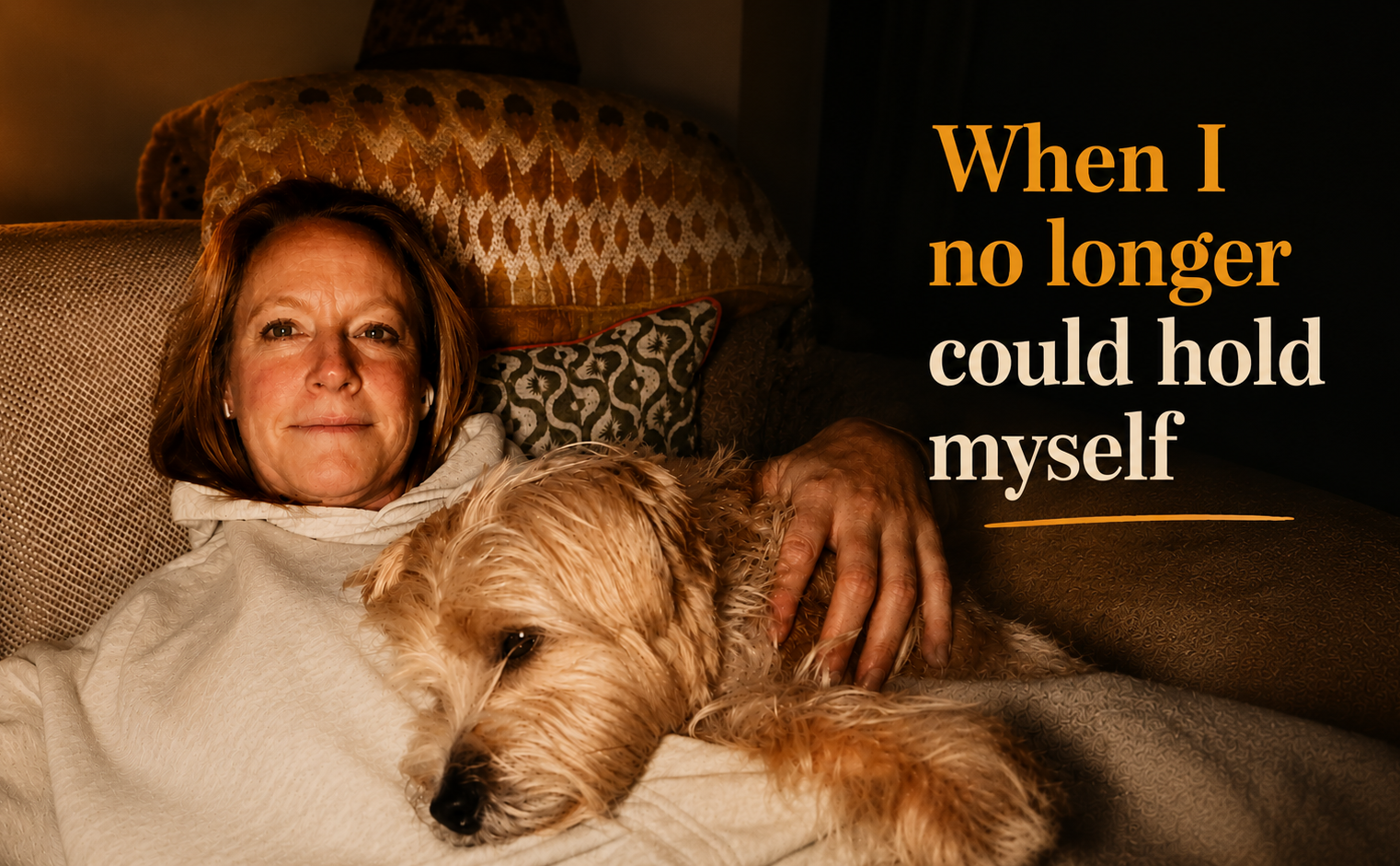
Part 1 of The Shock Field Series
Helplessness, Self-Reliance & Nervous System Healing
A couple of weeks ago, I ended up in A&E with a herniated disc and severe sciatica after experiencing the most intense nerve pain I have ever known.
What began as back pain became something far more overwhelming — waves of electric shock-like pain and full body spasms that completely overtook my nervous system. At moments all I could do was scream as the pain surged through me. There were hours on the floor, in hospital corridors, morphine, tears, laughter, exhaustion, fear, tenderness and eventually the humbling reality that I could barely move without help.
And ever since, I’ve found myself sitting in inquiry with what this experience opened.
Not trying to rush to meaning.
Not trying to resolve it too quickly.
But allowing myself to get close to what was actually felt.
One of the first things I noticed was how quickly an old pattern arose.
When my neighbours helped me call an ambulance and asked whether I wanted them to come with me to the hospital, my immediate response was:
“No, I’m fine. I can do this.”
Even while my body was in excruciating pain, there it was:
the reflex to hold myself.
To manage alone.
To have my own back.
And it was almost startling to notice how immediate that response felt.
Yet what unfolded around me was not aloneness.
My neighbours stayed with me for hours on the floor while we waited for the ambulance.
A friend gently encouraged me to call family rather than deciding for them that they had too much going on. My brother came to the hospital and stayed for hours beside me while we waited in A&E.
And in the days that followed, my brother and family took me into their home while I recovered and could barely move properly on my own.
Alongside that came messages from friends, family and others who had lived through similar pain, bringing empathy and reassurance at a time where I felt incredibly vulnerable.
Again and again there was care.
Support.
Love.
Holding.
And somewhere in the midst of all of that, something began to soften.
Because perhaps one of the deepest fears in my system has always been helplessness.
The fear that if I truly could not hold myself together, there would be no one there.
That I would somehow be lost in the vulnerability of it all.
And I can also feel how much this fear is intertwined with illness itself.
My mother was ill for much of my life, and I wonder whether my nervous system learned very early that illness carried fear and uncertainty — that bodies could become fragile and life could suddenly reorganise itself around coping, care and survival.
So when my own body suddenly became incapacitated, it touched something far older than physical pain alone.
There is something almost painfully poignant about the fact that this all happened through my back — and the revelation of the difference between a grounded, supported back and a braced one.
Because I can feel how much of my life has been shaped around holding myself up.
Bracing.
Enduring.
Pushing through.
Having my own back no matter what.
And I am also beginning to wonder whether the strength I built around holding myself may have been keeping me at a distance from the very thing I longed for.
Over-self-reliance can look powerful from the outside.
And in many ways it was adaptive.
It helped me cope.
Function.
Survive.
Even build a successful life.
But I can also feel how it kept love, support and holding at a certain distance.
Because truly receiving support is vulnerable.
To let yourself lean on another human being is to enter the terrifying possibility of dependency, loss and disappointment.
I wonder whether somewhere in me there has long been a quieter belief:
“I have to hold myself because support may disappear”,
And perhaps that is when self-reliance becomes something more than independence.
It becomes protection.
Protection against needing too much.
Protection against being let down.
Protection against the grief of losing connection.
And suddenly my body interrupted that strategy completely.
At first, I think part of me experienced that as terrifying.
But another part of me began to discover something else.
That helplessness was not the end of the world.
That vulnerability did not make me disappear.
That support could arrive.
That I could be held.
Not as an abstract spiritual idea.
Not as something I teach or understand intellectually.
But as something directly lived in the body.
And perhaps what has surprised me most is that the deepest impact of this experience has not only been the physical pain itself.
It has been what this experience revealed about the nervous system.
About self-reliance. About vulnerability. About the ways trauma and survival live in the body. About how deeply we long to be held. And perhaps most of all, about what becomes possible when we stop trying to hold ourselves alone.
I have the strange sense that this experience opened a doorway into something much older, more tender and more ancient within me.
That is the inquiry I want to explore more deeply in Part 2.

View comments
+ Leave a comment