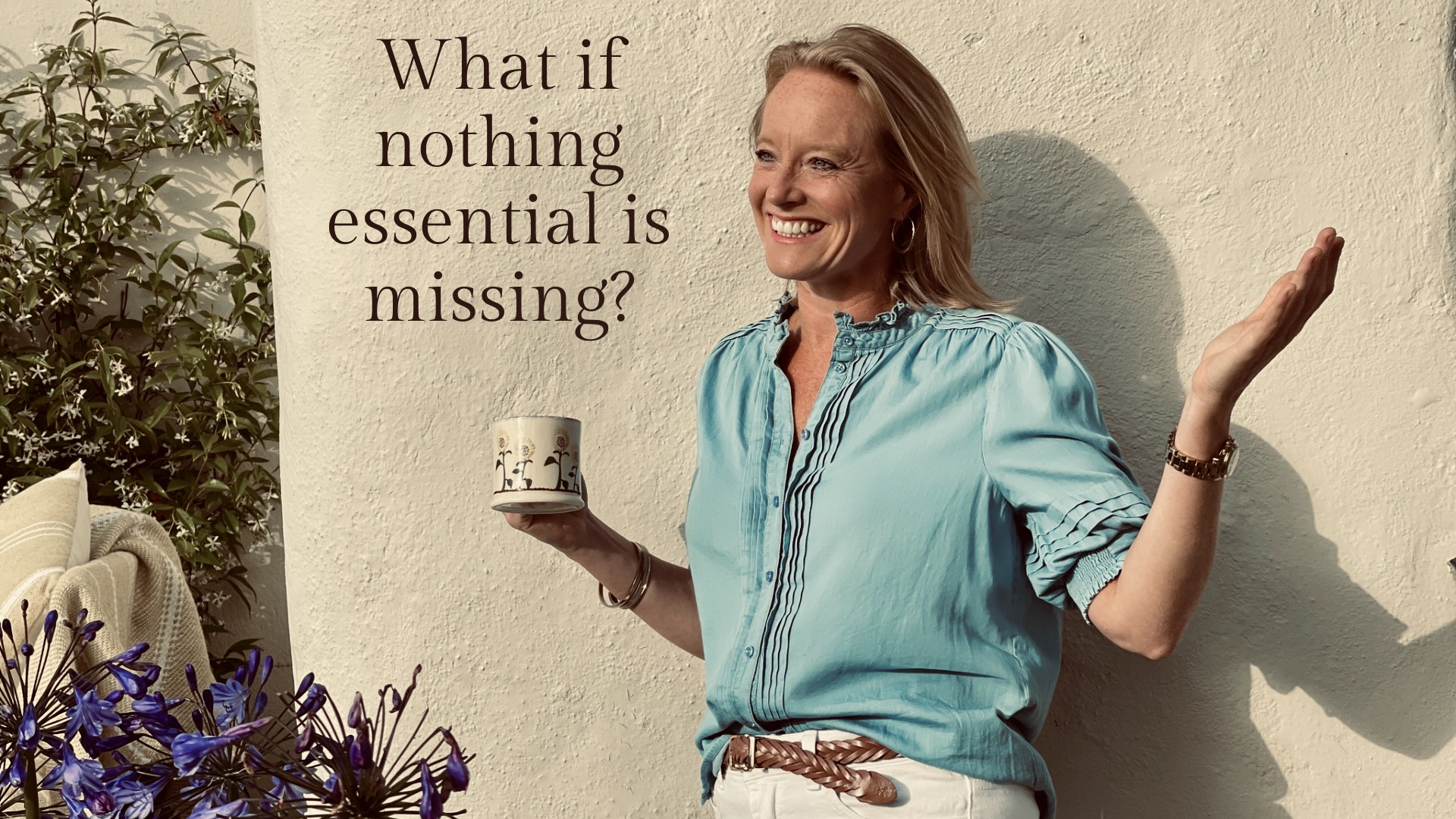
What if healing isn’t about becoming whole, but about remembering that we already are?
I’ve been sitting with this question since writing She Who Is Never Not Broken.
That piece began with Akhilandeshwari — “she who is never not broken” — and the possibility that healing doesn’t lead us towards some final state of wholeness. That there is no finished version of ourselves waiting at the end of all this work. No point at which we can say, I’ve done it. I’m healed. I’m whole.
And if there is nowhere to arrive, then what are we actually doing when we heal, grow and develop?
The more I stay with that question, the more I find myself looking at healing differently.
Healing has less to do with fixing or getting rid of something, and more to do with remembering something we have forgotten.
That we are already whole.
The path isn’t towards becoming someone new. It is a coming home to ourselves — something I have been exploring for many years.
And sometimes, even the search for who we really are can become part of the forgetting.
What feels newer to me is taking that idea one step further:
What does it mean to meet life from the sense that nothing essential is missing?
What do I mean by wholeness?
For me, wholeness isn’t the absence of pain, fear or difficulty. It isn’t having everything figured out, or reaching some state where every part of us has finally been healed.
It is the sense that nothing essential is missing.
That at the deepest level, we don’t need to become someone else, or have the right person, the right job, the right amount of money or the right circumstances to experience the peace, joy and aliveness that are already here.
We don’t need to fix ourselves into wholeness.
Our fear, grief, shame, anger and longing are all part of being human. So are the protective patterns we developed along the way. Many of these patterns began for very good reasons. They helped us survive, stay connected and navigate experiences we didn’t yet have the capacity to understand.
None of these things are bad or wrong. They don’t need to be excluded for us to be whole.
And this matters because if I believe I am fundamentally incomplete, the work of life can quietly become completion.
I have to become more confident. More successful. More loved. More secure. More healed. More certain.
And I keep looking outside myself for the thing that will finally make me feel whole.
Whereas if wholeness is already present, the question changes:
“What do I need to become before I can finally feel that I am enough?”
becomes:
“What would it be like to live as though nothing essential is missing?”
That is a very different way of meeting life.
The idea of coming home to ourselves isn’t new to me. I’ve been learning, exploring and integrating that for years.
What feels different now is beginning to notice what happens when that becomes the place from which I meet life.
When what we learned becomes who we think we are
If something essential is already here, why is it so easy to lose touch with it?
We all develop ways of being in the world. Some begin very early, long before we can understand what is happening. We learn what keeps us connected, what creates safety, what gets approval and what makes us less vulnerable. We learn to anticipate, achieve, please, control and keep moving.
Over time, these ways of being can become so familiar that we stop experiencing them as things we learned. They become part of our identity.
The perfectionist.
The people pleaser.
The responsible one.
The one who has to keep everything under control.
The high achiever.
The fiercely independent one.
Different patterns. Different strategies. And often, underneath them, a longing to feel safe, loved, valued or enough.
These aren’t necessarily things we see as problems. Many are qualities we’ve been praised for. They can become strengths, achievements, even part of the story we tell about who we are.
And because they have served us well, we can become attached to them.
They feel like me.
What began as something we learned to do can become something we believe we are.
I see this often in my work with people. Someone comes with a pattern they’ve spent years trying to change, only to discover the intelligence underneath it:
“This is how I learned to stay safe, connected, valued or in control“.
These strategies can be extraordinary. They help us function, care for others, achieve, build lives and survive things we didn’t know we could survive.
So I don’t want to think of these parts as things that need to be defeated. They need to be understood and honoured.
And sometimes, as we become safer and more resourced, we can see that the circumstances these strategies were created for are no longer the ones we are living in.
We may not need them to run the whole of our lives anymore.
What lies beneath the pattern
And beneath all of this, I have a sense of something more essential.
For me, essence is found in the qualities that bring me into aliveness, presence and connection. I recognise it in moments when I’m not trying to become anything, prove anything or protect anything, but am simply more fully myself.
There is something deeply familiar about those moments, as though I’m not discovering something new so much as remembering something I already knew.
What feels different now is beginning to notice what happens when this becomes the place from which I meet life.
From becoming to inhabiting
If we have spent years adapting ourselves to life, it is easy to turn growth into another project of becoming.
We identify the parts we don’t like and set about improving them. We strive to become more knowledgeable, clearer, more confident, more resilient, more successful… more healed, more whole.
There is always another layer to work on, another pattern to release, another version of ourselves to become.
At some point, we have to ask ourselves:
When does growth stop being about becoming better and start being about becoming more deeply ourselves?
Our nervous systems are very familiar with striving: hoping, waiting, preparing, protecting and moving towards something that hasn’t arrived yet.
We know how to become.
We are much less familiar with simply receiving what is already here.
And this is where something is shifting for me.
Moving from lack to enough
When we are organised around lack, we move through the world looking for what will finally make us feel enough. We reach for the relationship, the success, the recognition, the next achievement — often without realising that we are asking these things to give us something we believe we don’t yet have.
But what happens when we begin somewhere else?
When we don’t ask the world to complete us, but meet it from the felt sense that we are already supported, already loved, already safe enough, already enough?
The movement is different.
We can still want more. We can still create, build, lead, love and change things.
But we’re no longer asking those things to complete us. We can desire them without grasping for them, or clinging to them as though they hold the key to our wholeness.
Changing the way we meet life doesn’t necessarily mean changing what life brings us. It means changing the place from which we meet it.
This is the piece I am beginning to understand more deeply in my own life.
And this brings me back to a question from my teacher, Patrick Connor, that has stayed with me:
How do we learn to live as though nothing essential is missing, before our circumstances give us any reason to believe it?
It’s easy to feel supported when everything is working. Easy to feel enough when we’re succeeding, loved when we’re being chosen, safe when nothing is threatening us.
The deeper inquiry begins when the evidence isn’t there.
When the relationship ends.
When the work doesn’t succeed.
When someone doesn’t choose us.
When we’re grieving.
When we don’t know what happens next.
When the identity we’ve relied upon begins to loosen.
This is where the question becomes less about what is happening, and more about how I meet what is happening.
Can I allow what is happening without making it responsible for telling me who I am?
Can I experience difficulty without concluding that something is wrong with me?
Can I allow uncertainty without needing to resolve it before I can feel enough?
Can I be where I am without turning that into evidence that I haven’t developed enough, healed enough or become enough?
This isn’t positive thinking. It isn’t pretending everything is fine or rising above pain.
It is learning to meet life from somewhere other than lack.
Welcoming everything home
I’m not sure we ever finish this work.
We will forget. We will become identified again with old patterns. We will find ourselves striving, protecting, contracting and trying to become something different.
That isn’t failure. It’s part of being human.
The invitation isn’t to transcend any of this. It is to recognise what is happening without making any one part of it the whole truth of who we are. To honour what protected us, listen to what is still afraid, and make room for what is here.
We stop asking:
How do I become whole?
And begin asking:
What would it be like to live as though nothing essential is missing?
Not because everything is resolved.
Not because we have healed enough.
Not because we have finally become the person we think we need to be.
But because perhaps wholeness was never something we had to become.
Perhaps it is something we can begin to remember — even here, even now, with all of our humanity intact.
Maybe coming home is about welcoming everything home.

Dear Abby,
I read you article sitting on my balcony in Berlin and started it although I wanted to go running (to become healthier:) and it touched so much your thoughts! Thank you dear Hiking friend! Greetings from Beate